

Identity Kills

note: sorry I haven’t been very active on here. it’s actually because I have a book deal….news on that to come. anyway for now here’s something I wrote today about identity.
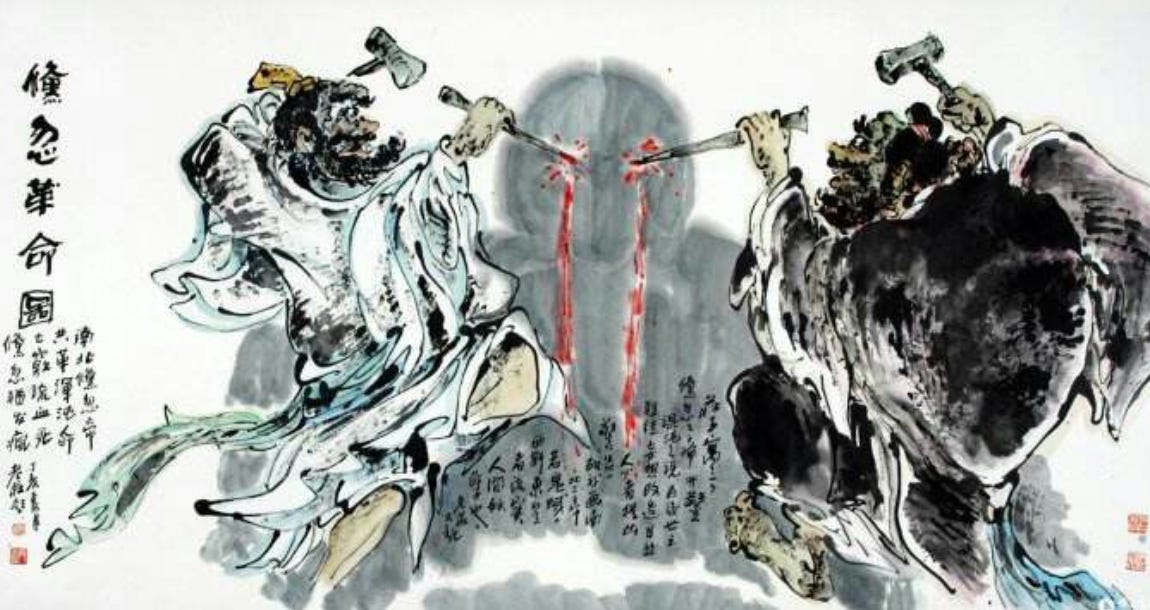
Alexander Douglas’s new book Against Identity starts with a Taoist parable:
“Long ago, in a mythical realm in what is now China, there were three emperors: Shu, Hu and Hundun. Shu was the Emperor of the Southern Sea. Hu was the Emperor of the Northern Sea. Between them was the Centre – the territory of Hundun. The two emperors of the seas frequently met in the Centre, where Hundun always welcomed them with perfect hospitality. Shu and Hu, like us, had openings in their heads: eyes, ears, mouth and nostrils. Hundun, however, had none. He was blank and featureless. One day, Shu and Hu decided to bore holes into him, so that he too could have features like theirs. Each day, they drilled a new hole. And on the seventh day, Hundun died.”
Douglas’s reading of the tale is: the imposition of identity is an act of violence.
Let’s think of this in terms of art. Douglas again:
“Pronounced in Cantonese, [Hundun] is ‘wonton’ - the name of the famous Chinese dumplings, which can wrap up a variety of fillings. Thus, Hundun’s name implies that even though he is unformed, he contains potential forms, as an uncarved block contains all the shapes a sculptor could make from it.”
If Douglas’s sculptor imposes an identity, or allows an identity to be imposed on her work, she’s in danger of mortally wounding it. Something of the world- of opinions - will intervene and strip it of its interesting intangibility. Of course she has to carve something- she can’t just exhibit an uncarved block. Shu and Hu will inevitably get involved. But dealing with them is a dangerous process. A good sculpture will retain something of the uncarved block- the phase prior to Shun and Hu’s entrance.
Let’s imagine Shu and Hu represent politics. Most would probably agree that a lot of the identitarian art from the ‘woke era’ had a dead quality to it. That’s because it had been killed. An inverted version of this continues today: most of the ‘anti-woke’ or ‘vibe-shift’ art we now see is also dead on arrival. Which isn’t to say that art can’t or shouldn’t be political. It’s just clear that, in most cases, an artist will adopt a political identity despite being, deep down, a fairly apolitical or politically incurious person. Or a partisan political pundit will mistake themselves as an artist and try to make a piece of art.
This is especially hazardous in music because musicians are dumber than other artists. Nietzsche, drawing on Schopenhauer, believed music is Dionysian (primal, ritualistic, pagan, booze-fuelled) while most other art forms are Apollonian (intellectual, reasonable, high-minded). Most music, then, isn’t suited to being good or right. Maybe this is why most interviews with musicians are so boring- bland attempts at describing something indescribable or jumbles of half-formed political and cultural thought.
In more insidious cases, political identity is imposed on an artist. A good study of this is Erasure by Percival Everett- a satire about the way black writers are routinely encouraged to write about race in a way that satisfies the political impulses of white liberal readers and publishers. In these cases, Shu and Hu are set on the artist. They arrive at the door with a threat: your identity is valid, let us in if you want to be successful.
But, in a broader sense, identity imposition is an occupational hazard for any artist. Maybe Shu and Hu will kill our sculptor’s work using more amorphous weapons: aesthetic trends. Perhaps they’ll convince her to emulate a cohort of artists whose group identity is beginning to get some attention. Or they’ll team up with the gallery representing her and pressure her into it. If she lets this happen, she will be on the hamster wheel forever: both fleeing and chasing identity. This can never be fully avoided. In music, it comes with the territory. It’s part of the fun, even: genres, subcultures, tribes. What is the history of pop music in the 20th century but one big, enjoyable exercise in identity imposition? But I think this tends to be more fun for the consumer than the artist.
Despite my various complaints about today’s devalued music industry, I think the splintering of cultural identity and general descent into atomised meaningless has some upsides for the artist. My mother’s music, for instance, was sidelined in the 90s because she didn’t sonically or aesthetically fit the dominant trends during an era in which music retained a coherent, linear narrative. This is no longer the case because no one can figure out what modern musicians are supposed to look, act or sound like. There is freedom in this. But I think the majority of artists don’t see it this way and crave identity. I certainly feel that way sometimes.
It’s a strange situation we find ourselves in: our identities are meaningless and regurgitated yet we cling to them more desperately than ever. This goes beyond art and touches on something more high-stakes. Culture and politics are simultaneously identity-obsessed and in a state of identity crisis. Social media is partly responsible. But, beyond that, you have to wonder if the lack of coherent identities has created a kind of bloodlust in the Shus and Hus of the world. People desperately cling onto increasingly niche yet popular group identities: nationalist bodybuilder, Catholic hipster, craft beer enthusiast, hardcore punk fan. Or they spend their time on X hysterically taxonimizing racial identities. Everyone caught in the furious dance of defending and imposing their flimsy identities.
In the UK, a disturbing political version of the parable has played out around the proscription of Palestine Action. Sam Kriss writes about the absurdity of the situation:
“What makes things even more difficult is that Palestine Action does not exist. Unlike other terrorist groups—like, say, ISIS—they dissolved as soon as the proscription took effect. Nobody will ever be prosecuted for being a member of Palestine Action, because Palestine Action has no members. No one will get in trouble for funnelling money to Palestine Action, because there is nothing to receive it. But you will still be arrested if you go out in public and say ‘I support Palestine Action,’ even though those words don’t actually refer to anything at all. This is just a succession of meaningless sounds that summons policemen to take you away.”
This is similar to what I described above: flimsy identities imposed flimsily to disproportionately oppressive effect. Though it takes things a step further: entirely new counter-fit identities have been created. The 90 year old terrorist. The blind terrorist in the wheelchair. The most disturbing aspect of this is how it echoes Israel’s own genocidal identity politics. By overlaying the ‘Hamas supporter’ identity onto every Palestinian, they too have created a counter-fit identity which only makes sense it a distorted reality. A world where children hold political opinions and over 2 million people think in terrorist lockstep. As in the case of the proscription, the pathetic and absurd collides with the oppressive.
There is something horrifying in this contrast: the crudeness of the drawn face and the violence inflicted in the name of it being real.